

“This, in short, shows serious over-hauling of training system of IAS & IPS officer,” a Bihar court has said while convicting the then Rohtas SP for contempt and imposing a notional fine of Re. 1 for not carrying out its directions.
Thank you for reading this post, don't forget to subscribe!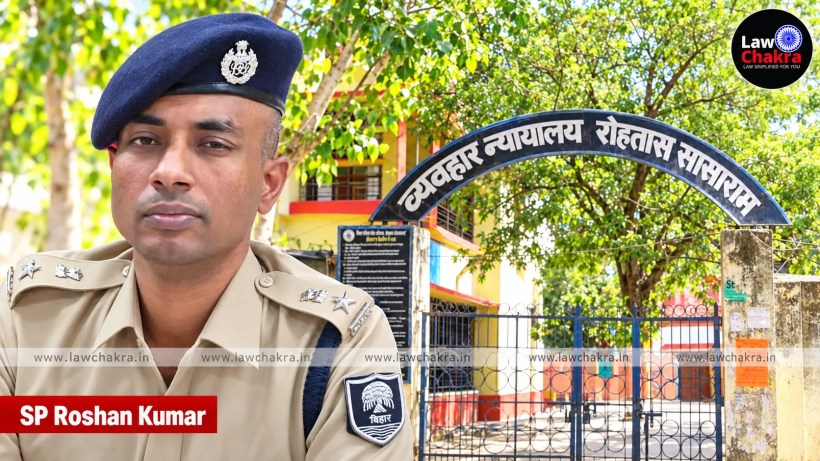
Sasaram: The court of the District and Additional Sessions Judge-IV, Rohtas at Sasaram, has convicted Raushan Kumar, then Superintendent of Police, Rohtas, and now posted as Senior Superintendent of Police, Saran, under Section 384 of the Bharatiya Nagarik Suraksha Sanhita (BNSS) for wilfully not complying with its directions, imposing a notional fine of Re. 1 [State through Court of District Judge-IV, Rohtas at Sasaram v. Raushan Kumar, S.P., Rohtas].
The order of September 29, 2026 was passed by District and Additional Sessions Judge Anil Kumar in Criminal Misc. No. 82/2026, arising out of Sessions Trial Case No. 95/2023 (Sasaram Darigaon P.S. Case No. 183/2022). The court opened it by calling the case, against the so-called ‘Steel frame’, “highly unfortunate but become inevitable” and aimed at “restoring the dignity of the District Courts”.
What the judge said about officer training
Judge Anil Kumar recorded, under the head of observations:
“Above-discussion shows serious flaws in the training of such I.P.S. officer where they should have been imparted training to respect and comply the court orders but they treat the subordinate court as the inferior one.”
He then directed that a copy of the order go to the Union Ministry of Personnel and Training:
“This, in short, shows serious over-hauling of training system of IAS & IPS officer. Hence, office clerk is directed to send a copy of this order to Ministry of Personnel, and Training of the Central Government so that training system of ‘Steel frame’ could be attuned to our democratic set-up.”
A notional fine, and the reason for it
The court found the officer “guilty of wilful flouting of court orders including the present one” and convicted him under Section 384 BNSS, the successor to Section 345 of the Code of Criminal Procedure. It took note of his counsel’s prayer for leniency, but said it was keeping in mind that such an attitude is “contagious which will eventually plague the Superior Courts” and that it wished “to nip such attitude towards the court in bud”. The officer was therefore “notionally fined only a sum of Rs. 1/- (one rupee only)”.
How a kidnapping trial ended in a contempt case
The contempt case stems from Sessions Trial No. 95/2023, in which the court convicted ten persons under Section 364-A of the Indian Penal Code, even though the victim and his informant-son turned hostile. During that trial the court had sought fresh criminal antecedents of the accused from the Superintendent of Police. According to the order, the report came a month after the case was disposed of, was copied from the case diary and carried no recent antecedent.
The order records that, in the judgment, the Superintendent of Police was directed to get the matter investigated and take action regarding the victim’s alleged involvement in the cannabis business and the informant-son’s alleged gambling den, both of which the court said had emerged during the trial. A second direction was to get an FIR registered against the victim for perjury under Section 193 IPC, the court saying it had come to know informally that the victim, kidnapped for a ransom of Rs. 1.50 crore, had turned hostile after taking a bribe of Rs. 20 lakh.
These are the trial court’s own remarks; the victim is not identified here and no view is expressed on them.
The judgment was sent to the Superintendent of Police and to the Director General of Police, Bihar. When the Additional Public Prosecutor pointed out that, a year on, the victim was free and no case had been registered, the court issued a show-cause notice dated July 4, 2026, served on July 6, asking for a reply in three days. The order says there was no reply even after ten days, and on July 16, 2026 the court recommended disciplinary action to the Director General of Police and the Chief Secretary, asking for an action-taken report within 15 days. It says neither sent anything. The proceedings under Section 384 BNSS were registered on August 17, 2026.
The defences, and the evidence
On August 22, 2026 a private lawyer appeared for the officer and a reply dated August 20, 2026 was placed on record. It took two main defences: that he had not received the judgment of August 28, 2025 and the sentence order of August 30, 2025, and that the Assistant Public Prosecutor had not informed him about the judgment or the show-cause notice. The court said the presumption under Section 114(e) and (f) of the Evidence Act operated against him because the judgment had been sent to the Superintendent of Police, Rohtas, under D.B. No. 216 dated September 2, 2025, and that it was unfair to shift the burden to the prosecutor.
Dates for his evidence were fixed on August 28 and on September 7, 11, 14 and 22, 2026, but the order says he did not appear and instead tried to pressurise the court to drop the proceedings by approaching “eminent person”. It records that he approached the then Inspecting Judge, who called the presiding officer to Patna with the records by an email of September 24, 2026, a request the presiding officer said he “humbly refused” as an “extra-legal diktat”. As no evidence was produced, the court held that wilful and deliberate non-compliance stood proved.
Other instances the court cited
Under the head of antecedent conduct, the court said it had often commented on police conduct in bail orders and recommended action, and cited instances it said went unanswered: an investigating officer who complained in court of being abused by a local man, a station house officer it said had turned a simple road-rage case into robbery with hurt, a case in which two persons were allegedly beaten and money demanded, and a complaint it forwarded that was sent back to the same station officer for investigation.
It said the officer “sided with ‘apparent’ dishonest officer” and that these instances showed a “callous and indifferent attitude towards the court” that raised “serious doubt over his integrity”. In its conclusion it added that he had once earlier been excused costs of Rs. 10,000 for not replying to a show-cause notice on non-execution of a distress warrant and had been warned to be cautious.
The court did not stop at the police. It said it had no good experience with IAS officers either, District Magistrates in particular, noting that despite the Supreme Court’s direction in the Periyamal case that execution cases be disposed of within six months, show-cause notices in its execution matters had drawn no reply and costs of Rs. 10,000 no response, leaving attachment of the collectorate’s property as the only option.
It said the problem was not limited to Bihar, citing an execution matter under Section 174 of the Motor Vehicles Act in which the District Magistrate of Namakkal in Tamil Nadu did not reply even once, the petitioner was asked to withdraw and approach the Madras High Court under Article 227, and the District Magistrate’s unconditional apology was later sent to the Sasaram court.
Directions to the authorities
The District Magistrate, Rohtas, was directed to deduct Re. 1 from the officer’s salary, with the help of the Treasury Officer or the District Magistrate, Saran (Chhapra), where he is presently posted, and deposit it in the Nazarat, Civil Court, Rohtas at Sasaram, within 15 days. A copy of the order was to go to the Director General of Police, Patna, to be entered in his service record, preferably within 30 days, with information to the court. Copies were also directed to the Chief Minister of Bihar, the Chief Secretary of Bihar, the Senior Superintendent of Police, Saran at Chhapra, and the Ministry of Personnel and Training, Government of India, for information and needful.
Why the order matters
The order records a trial court invoking the contempt procedure in Section 384 BNSS against a serving police officer for not carrying out its directions in a criminal trial, and it sets out the steps before conviction: a show-cause notice, a recommendation for disciplinary action to the department and the State, a hearing at which the officer appeared through counsel with a chance to lead evidence, and a ruling on his defence of non-receipt of the judgment. The court chose a notional fine of Re. 1 but coupled it with an entry in the service record and copies to the State and Union authorities. The officer’s response to the order is not reported.
Case Details: State through Court of District Judge-IV, Rohtas at Sasaram v. Raushan Kumar, S.P., Rohtas | Criminal Misc. No. 82/2026 (CNR BRR0010080252026), arising out of Sessions Trial Case No. 95/2023 and Sasaram Darigaon P.S. Case No. 183/2022 | Court: District and Additional Sessions Judge-IV, Rohtas at Sasaram | Judge: Anil Kumar | Date of Order: September 29, 2026 | Outcome: Then Superintendent of Police, Rohtas, convicted under Section 384 BNSS and notionally fined Re. 1.
Appearances: The officer appeared through a private lawyer; name not given in the order.