

The Supreme Court Today (April 26th) dismissed all petitions seeking the complete cross-verification of votes cast using Electronic Voting Machines (EVMs) with Voter Verifiable Paper Audit Trails, or VVPATs and also rejected a return to the ballot paper system for elections.
Thank you for reading this post, don't forget to subscribe!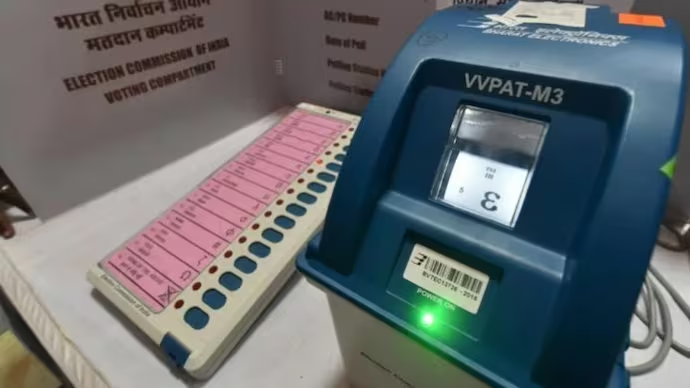
NEW DELHI: The Supreme Court today rejected petitions seeking 100% verification of votes cast on Electronic Voting Machines with paper slips generated through the VVPAT method.
The two-judge bench of Justice Sanjiv Khanna and Justice Dipankar Datta delivered a unanimous verdict.
The VVPAT machine is attached to the ballot unit of the EVM and provides visual verification for a voter’s vote by printing a slip of paper with the voter’s choice on it. This is later used to verify votes cast in five randomly selected polling booths per Assembly segment. The Opposition has been demanding that all VVPAT slips be cross-checked with the EVM votes.
“While balanced perspective is important, but blindly doubting a system can breed scepticism and thus, meaningful criticism is needed, be it judiciary, legislature etc, Democracy is all about maintaining harmony and trust among all the pillars. By nurturing a culture of trust and collaboration, we can strengthen the voice of our democracy,”
-Justice Datta said in the judgment.
Directions by Apex Court Today
- SC directs EC to seal symbol loading units for 45 days after symbols loaded to EVMs.
- SC allows verification of microcontroller of EVMs by manufacturer after poll results on request of candidates who stand second, third.
- SC says request for verification of microcontroller of EVMs can be made within 7 days of declaration of poll results upon payment of fees.
- If EVM is found tampered during verification, fee paid by candidates will be refunded: SC.
Previously in Apex Court
Supreme Court issued a host of queries to the Election Commission of India (ECI) on the functioning of Electronic Voting Machines (EVMs) and Voter-Verifiable Paper Audit Trail (VVPAT), Deputy Election Commissioner Nilesh Kumar Vyas appeared before the top court at 2pm today to issue clarification.
The bench of Justice Sanjiv Khanna and Justice Dipankar Datta said it cannot act on mere suspicion.
The Supreme Court said it is not the controlling authority for elections and cannot dictate the functioning of the Election Commission of India, a constitutional authority. The court has reserved its judgment as of now.
Answering the apex court’s query regarding micro-controllers, the Deputy Election Commissioner said,
“The micro-controllers are one-time programmable. Each of the three units – CU (controlling unit), BU (balloting unit) and VVPAT – have their own micro-controllers, which cannot be accessed physically. The one-time prgramme is burnt into them.”
Further while responding to concerns raised by Advocate Prashant Bhushan, appearing for petitioner — Association for Democratic Reforms, the court said,
“If you are prejudiced about a thought-process, then we cannot help you… we are not here to change your thought process.”
“Can we issue a mandamus on the basis of a suspicion? The report you are relying on says that there is no incident of hacking yet. We are not the controlling authority of another constitutional authority. We cannot control the elections. The judgment of Supreme Court did say (use) VVPAT and it was followed. But where did it say match all slips, it says 5 percent, Now let us see if any candidate apart from this 5 percent say that there are instances of misuse,”
-the Court told the petitioners.
Pertinently, the Court also said that it would consider passing directions to strengthen the EVMs system since going back to ballot paper was out of question.
“The only option would be to go back to ballot papers then you see. Let us see what can be done if any safeguards needed we will see what is needed to strengthen the current system(EVMs)”
-it said.

Amid the Opposition’s apprehensions regarding the EVM voting system, the petitions seek a direction to cross-verify every vote cast on EVMs with the paper slips generated by the VVPAT system. Currently, this cross-verification is done for five randomly selected EVMs in every Assembly constituency.
In the earlier hearings, the petitioners raised the issue of public trust and drew comparisons with European countries that have gone back to the ballot voting system. The court shot down such comparisons, observing that the challenges here are different. The Election Commission, on its part, stressed that the current system is foolproof.
An EVM has a control unit and a balloting unit. These are connected by a cable. These are also connected with a VVPAT-Voter Verified Paper Audit Trail machine. This machine enables a voter to see if the vote was cast properly and went to the candidate he/she supports.
As proceedings began this morning, the court sought some clarifications from the poll body about microcontrollers in the system and if they can be re-programmed.
The Election Commission responded that all three units have their own microcontrollers and these can be programmed only once. Mr Bhushan contended that these microcontrollers have a flash memory that is re-programmable.
“To say that it is not re-programmable is incorrect,”
-he said.
The court said it has to trust the poll body’s technical report.
“They are saying quantum of flash memory is very low. They can store 1024 symbols, not software. They say that as far as microcontrollers in the CU (control unit) is concerned, it is agnostic. It does not recognise the party or symbol, it knows the buttons,”
-Justice Khanna said.
READ/DOWNLOAD JUDGEMENT-
Click Here to Read Previous Reports on VVPAT
FOLLOW US ON YOUTUBE FOR MORE LEGAL UPDATES
