

The IMA given “an ultimatum” of two days to meet their demands, which include declaring hospitals as safe zones, defining security measures and bringing in the Healthcare Service Personnel and Clinical Establishments Bill, 2019. As per the draft law, those committing violence against healthcare professionals shall be sent to jail for six months to five years, with a fine of Rs 50,000 to Rs 5 lakh.
Thank you for reading this post, don't forget to subscribe!
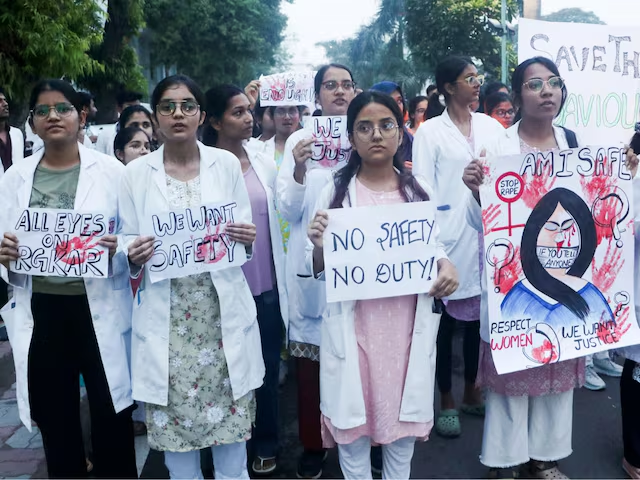
WEST BENGAL: The tragic case of the murder and rape of a Kolkata doctor underscores the ongoing and alarming issue of violence against medical professionals in India, a concern that has been repeatedly voiced by the Indian Medical Association (IMA), the country’s largest doctors’ lobby.
On August 9, a horrifying incident unfolded at R G Kar Medical College in Kolkata when the lifeless body of a woman resident doctor was discovered, bearing multiple injuries. The doctor, who had been working a grueling 36-hour shift, had retreated to the seminar room around 2 a.m. for some rest, as the hospital lacked a designated duty room for doctors. Preliminary investigations have raised the grave suspicion that she was sexually assaulted.
In response to this brutal crime, the IMA has issued “an ultimatum” demanding swift action within two days. Their key demands include the declaration of hospitals as safe zones, the establishment of clear security measures, and the urgent passage of the Healthcare Service Personnel and Clinical Establishments Bill, 2019.
This proposed law, which had been shelved after a period of public consultation, prescribes that individuals committing violence against healthcare professionals face imprisonment ranging from six months to five years, along with fines ranging from Rs 50,000 to Rs 5 lakh.
RV Asokan, the national president of the IMA, expressed his deep concern, stating,
“While such abuse has become a routine occurrence in India, but unfortunately, it takes such severe incidents to draw attention to the problem.”
He further emphasized the vulnerability of healthcare workers, remarking,
“This is the safety status of big government hospitals; then imagine how safe the public health centres (PHCs) are in remote areas. It’s the right time to bring back the Healthcare Service Personnel and Clinical Establishments Bill, 2019, which was shelved after extending the bill for public comments.”
Asokan highlighted that the IMA had collaborated with the Ministry of Health and Family Welfare to draft this bill and has since been advocating for a central law to protect doctors and hospitals from violence.
The IMA, which represents 3.5 lakh doctors across India, has condemned the incident as “brutal and cruel” and asserted that it has “shaken the conscience” of the entire nation.
The association is currently coordinating with its West Bengal branch to address the situation.
“We are dealing with the situation in consultation with our West Bengal branch. What we want from the West Bengal government is an impartial and thorough investigation of the case, including a detailed inquiry into the conditions that enabled the crime, along with urgent steps to improve the safety of doctors, particularly women, in the workplace, and the punishment of the culprits,”
-the IMA stated.
This tragic event has reignited the call for stronger protections and has once again highlighted the dangerous conditions under which medical professionals, especially women, continue to work in India.


HEARING TODAY IN CALCUTTA HIGH COURT
The Calcutta High Court Today (Aug 13th) conducted a hearing concerning multiple petitions related to the brutal rape and murder of a 2nd Year PG student at RG Kar Medical College and Hospital. The incident occurred after the student had completed her midnight rounds and had gone to rest in the campus’s seminar hall.
A division bench consisting of Chief Justice TS Sivagnanam and Justice Hiranmay Bhattacharya expressed serious concerns towards the state government following allegations that the police had initially registered the deceased’s death as a suicide.
It was reported that this information was relayed to the student’s parents, who were made to wait for hours before they were allowed to see her body. The bench sternly observed:
“If it is a fact that somebody called the parent and told them that it was sickness and then suicide, there is a miss somewhere. If this is true that they were made to wait and misled, then the administration is loitering with them. You cannot treat the deceased like this. There should be more sensitivity. Suppose the doctors are made parties and they claim that the principal blamed the deceased and said she had psychosis, it is very serious. By now a statement should have been recorded from the principal.”
Senior Advocate Bikash Ranjan Bhattacharya, representing the deceased’s parents, argued that the parents initially received a phone call informing them that their daughter had fallen ill. Upon arriving at the college, they were told she had committed suicide, but they were not allowed to see her body for nearly three hours.
When they finally saw her body for identification, the nature of the injuries convinced them that the incident could not have been a suicide. The senior counsel urged the court to transfer the investigation to the Central Bureau of Investigation (CBI), citing concerns that crucial evidence could be lost over time.
Additionally, it was brought to the court’s attention that Dr. Sandip Ghosh, the principal of the medical college, had resigned from his post citing “moral responsibility,” only to be appointed as the principal of Calcutta National Medical College, another government institution, within a few hours. The court expressed its disapproval of this sequence of events, remarking:
“If the principal has stepped down owing moral responsibility, rather serious that he is rewarded within 12 hours with another appointment. There is an apprehension that with lost time there is something that will go wrong. No man is above law, how did he step down and then be rewarded with another responsibility? The principal is the guardian of all doctors working there; if he doesn’t show any empathy, who will show? He should be at home, not working anywhere. So powerful that a government counsel is representing him? The principal will not function. Let him go on long leave. Otherwise, we will pass an order.”
In response to these allegations, the state government contended that a thorough investigation was already underway and that no further probe was necessary. It was also mentioned that a case of unnatural death had been registered since no formal complaint had been filed when the deceased’s body was found.
The court, however, was not satisfied with this explanation and rebuked the state for its handling of the situation:
“We can’t understand. You didn’t find the body on the road? The principal could have been the complainant. So you will reward him?! (for not filing a complaint) That’s enough. We have heard. You are protecting him. This is unacceptable. Suppose you find a body on the road— even then—every day the newspapers have requests for information. This is inhuman.”
The court has scheduled further proceedings for 2:45 pm to consider the petitioners’ request for transferring the investigation to the CBI.
Click Here to Read Previous Reports on Kolkata Doctor’s Rape
FOLLOW US ON YOUTUBE FOR MORE LEGAL UPDATES
