

Justice V. Ramaswami was the first Supreme Court judge in India to face impeachment proceedings, marking a historic moment in judicial accountability.

CHENNAI,TAMIL NADU: Justice V. Ramaswami, who passed away at the age of 96 in Chennai, was at the center of one of the most significant legal and political controversies in India’s judicial history. In the early 1990s, he became the first Supreme Court judge against whom impeachment proceedings were initiated. Though the motion ultimately failed, the case set a precedent in judicial accountability and political maneuvering within Parliament.
Background of the Impeachment Case
When Justice V. Ramaswami was sworn in as a Supreme Court judge on October 6, 1989, he may have thought his time in Chandigarh was behind him, but that was not the case. By mid-1990, reports surfaced about his extravagant spending while serving as Chief Justice of the Punjab and Haryana High Court.
Allegations included excessive purchases of furniture, home decor, and luxury items at public expense, such as multiple air conditioners, high-end sofas, wall-to-wall carpeting, and a large number of linens. His phone expenses alone amounted to lakhs, and he was accused of misusing government vehicles for personal trips. These included the:
“Purchase of eight air conditioners costing Rs 1,39,432, an extensive collection of quilts, mattresses, bed linens worth Rs 28,785, and 96 towels and napkins for Rs 11,000. Additional purchases included a dining table for Rs 45,795, multiple sofa sets ranging from Rs 14,051 to Rs 59,430, and wall-to-wall carpeting worth Rs 1,52,465. The residence was also stocked with 229 custom-stitched curtains for Rs 76,425, kitchenware worth Rs 25,047, and 18 suitcases and briefcases.
Further financial irregularities involved Rs 76,150 claimed for telephone expenses in Madras, a staggering Rs 9.10 lakh spent on phone calls at Rs 39,000 per month, and the unauthorized use of official vehicles, with Chandigarh cars being transported to Madras during vacations, requiring an assistant registrar to fly back to retrieve them. Additionally, 25 silver maces were ordered at exorbitant prices, raising further concerns about financial mismanagement.”
These revelations prompted the Supreme Court Bar Association to call for his impeachment and urged the Chief Justice of India (CJI) to take action.
Initial Steps Towards Impeachment
Amid growing concerns, Chief Justice of India (CJI) Sabyasachi Mukherjee took an unprecedented step on July 20, 1990, advising Justice Ramaswami to refrain from discharging judicial functions until his name was cleared. This announcement was made in a packed courtroom just after a hearing on the Bhopal Gas Tragedy settlement case. Justice Ramaswami, in response, applied for six weeks of leave starting July 23, 1990.
Former President R. Venkataraman, in his memoir My Presidential Years, expressed disapproval of the CJI’s move, arguing that
“it exercised a power not explicitly provided for in the Constitution”
He also suggested the creation of an ombudsman for such cases, but this proposal was not taken up.
Formation of an Inquiry Committee
On March 13, 1991, just before the dissolution of the Ninth Lok Sabha, Speaker Rabi Ray admitted a motion signed by 108 Members of Parliament (MPs) seeking Justice Ramaswami’s impeachment under Articles 124 and 217 of the Constitution, which govern the removal of superior court judges for proven misconduct or incapacity.
A three-member inquiry committee was formed to investigate the allegations, comprising:
- Justice P.B. Sawant (Sitting Supreme Court Judge, Chairman)
- Justice P.D. Desai (Chief Justice of the Bombay High Court)
- Justice O. Chinappa Reddy (Former Supreme Court Judge)
Despite a petition challenging the validity of the impeachment motion due to the dissolution of the Lok Sabha, the Supreme Court upheld its continuation on October 29, 1991, through a 4:1 majority verdict.
The Parliamentary Debate and Voting
The impeachment motion was formally moved in the Lok Sabha by Somnath Chatterjee, a senior leader of the Communist Party of India (Marxist), on May 10, 1993. Chatterjee clarified that the motion was not against the judiciary as a whole but specifically targeted Justice Ramaswami’s behavior, which he deemed unsuitable for the position.
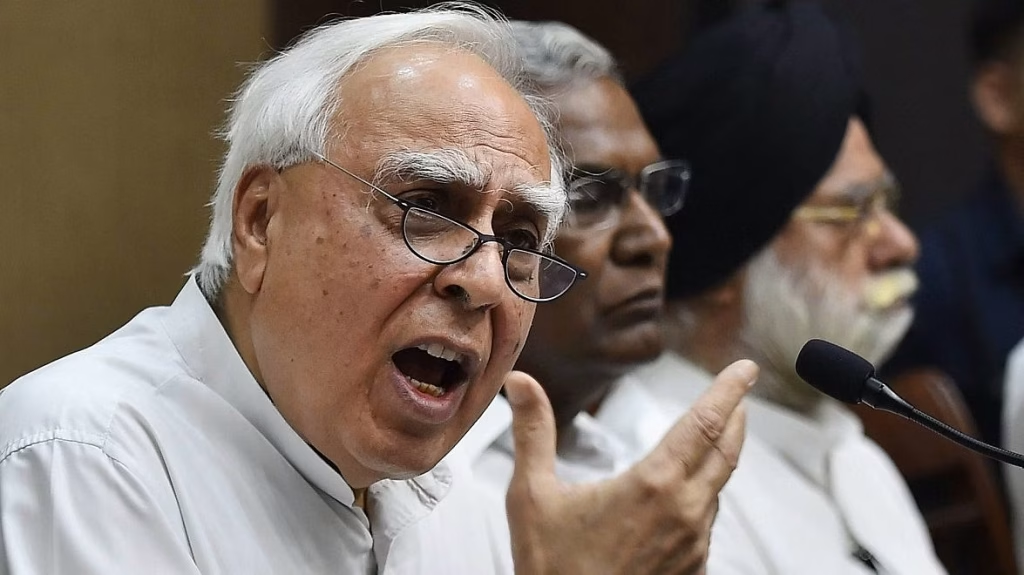
In defense, Senior Advocate Kapil Sibal, representing Justice Ramaswami, dismissed all
“11 allegations of financial misconduct, arguing that his client was not corrupt“
He highlighted
“Justice Ramaswami’s willingness to serve in Punjab during a time of unrest when other judges were reluctant to do so“
The ruling Congress party, under Prime Minister P.V. Narasimha Rao, initially allowed its MPs to vote freely but later informally instructed them to abstain from voting. Other parties, including the AIADMK and the Indian Union Muslim League, also abstained.
On May 11, 1993, when the motion was put to vote:
- 401 MPs were present in the House
- 196 MPs voted in favor of the motion
- 205 MPs abstained from voting
ALSO READ: Former Supreme Court Judge V Ramaswami Passes Away at 96
The Aftermath
The motion required a two-thirds majority of those present and voting to pass, as per Article 124(4) of the Constitution. Due to the large number of abstentions, the motion fell short of the required numbers, saving Justice Ramaswami from being formally removed from office.
Despite the failed impeachment, public and legal pressure continued, with many urging him to resign. However, Justice Ramaswami served out his tenure and retired in February 1994.
Political Implications

Justice Ramaswami’s impeachment proceedings had significant political ramifications. His son, Sanjay Ramaswami, was elected to the Tamil Nadu Legislative Assembly in 1991 on a Congress ticket. He later switched alliances and unsuccessfully contested the 1996 Lok Sabha elections from Sivakasi. In 1999, Justice Ramaswami himself contested as an AIADMK candidate from the same constituency but lost to Vaiko of the MDMK.
The impeachment proceedings against Justice V. Ramaswami remain a landmark episode in Indian judicial and political history. They highlighted the complexities of removing a judge and exposed the interplay between judiciary and politics.
While the motion failed, it sparked debates on judicial accountability, the need for clearer removal mechanisms, and the role of political influence in judicial proceedings.
READ MORE REPORTS ON SUPREME COURT
FOR MORE LEGAL UPDATES FOLLOW US ON YOUTUBE