

In India, the Motor Vehicles Act of 1932 outlines the authority of traffic police to impose fines for violations of traffic rules. It’s essential for drivers to follow all traffic rules, such as wearing a seatbelt in a car or a helmet when riding a two-wheeler. If caught violating these rules, the traffic police can impose a fine. However, it’s important to know who has the authority to enforce fines and what your rights are in such situations.

NEW DELHI: In India, following traffic rules is essential to ensure road safety. The Motor Vehicles Act of 1932 defines the roles and responsibilities of traffic police officers, outlining who can issue fines and under what circumstances.
Who Can Fine You for Traffic Violations?
According to the Indian Motor Vehicles Act of 1932, only traffic police personnel of the rank of Assistant Sub Inspector (ASI), Sub Inspectors, and Inspectors have the authority to issue fines for traffic violations on the spot. These officers are empowered to penalize drivers who violate traffic rules.
However, traffic constables do not have the authority to impose fines, as their role is purely assistive in nature.
The Process of Issuing a Fine
To impose a fine, the traffic police personnel must carry a challan book or an e-challan machine. Without one of these, they cannot legally issue a fine. “To impose a fine on you, the traffic police personnel should carry a challan book or an e-challan machine.”
Additionally, traffic police officers must be in uniform, and the uniform should display their name. If a police officer is not in uniform and is in civilian attire, you can ask for their identification proof.
“The traffic police should be donning the uniform, which should have his/her name. If the police personnel is clad in civilian attire, you can ask him/her to furnish identity proof.”
Fines Based on Police Rank
Different ranks of traffic police officers have varying levels of authority when it comes to fines. A traffic police head constable can only impose fines up to ₹100. However, ASIs and SIs can issue higher fines for more serious traffic violations.
“A traffic police head constable can only impose a maximum fine of ₹100. Only an ASI or an SI can impose a fine of more than ₹100.”
ALSO READ: Two High Court Lawyers Drown in Lucknow Pond: ‘Tragic Loss Shocks For Legal Community’
What To Do If Police Remove Your Vehicle Keys
A common misconception is that traffic police can remove the keys from your vehicle as a penalty for violations. However, this is not permitted by law. If a police officer attempts to remove your vehicle keys, you should immediately record the incident and report it to a senior officer at the nearest police station.
“If a traffic police personnel removes the keys from your car, you should film the incident and complain before the senior officer in the nearest police station.”
Essential Documents to Carry While Driving
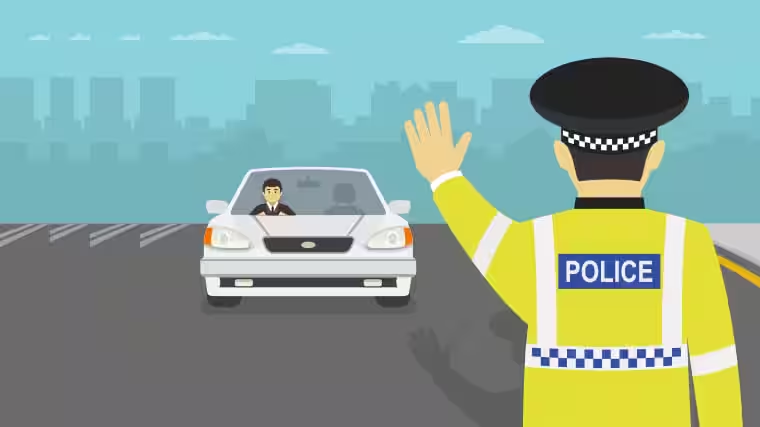
When stopped by traffic police, you should always carry the necessary documents.
When stopped by a traffic officer, the first thing they’ll ask for are the essential documents related to your vehicle. Always carry the following documents:
- Registration Certificate (RC)
- Pollution Under Control (PUC) Certificate
- Driving License (DL)
- Insurance policy document for your vehicle
These documents should be in their original form, but it’s acceptable to carry digital versions on your phone. Regardless of how you carry them, make sure they are easily accessible.
ALSO READ : LEGAL EXPLAINER | HOW TO FILE AN FIR ?
What Rights Do Traffic Police Have?
It’s important to understand the rights that traffic police officers have when stopping you:
- They can ask you to pull over for a traffic violation or suspicion.
- If you violate any traffic laws, they can seize your vehicle.
- If there is suspicion of wrongdoing, they may seize your driving license. However, they must provide you with an acknowledgment or receipt in return.
- If you are caught driving under the influence of alcohol or any illegal narcotics, they can arrest you immediately.
Paying the Fine and Handling the Situation
If you do not have the required fine amount on the spot, you can still pay the fine later. In such cases, the court will issue a challan, which needs to be paid before it. During this time, the traffic officer may take your driving license in their possession until the fine is paid.
“If you don’t have fine amount at the spot, you can deposit it later. In such a situation, the court issues a challan which needs to be paid before it. During this time, the traffic cop takes your driving licence in his/her possession.”

There is no provision in the Motor Vehicles Act 1988 for traffic police to take keys from anyone’s vehicle. He emphasizes that the only document you need to provide when asked by a police officer is your driving license. “There is no provision for traffic police personnel to take keys of anyone’s vehicle as per Motor Vehicles Act 1988. The driver should show the driving licence before the police personnel when asked.”
While it is crucial to follow traffic rules to avoid fines, it is equally important to understand your rights as a driver. Ensure that the traffic police officer is authorized to impose fines, and always carry your essential documents. If you find yourself in a situation where the officer oversteps their authority, remember to stay calm and report the incident as necessary.
BEWARE AND BE AWARE!
FOR MORE LEGAL UPDATES FOLLOW US ON YOUTUBE