

Rajya Sabha MP and senior advocate Kapil Sibal recently discussed key issues, including the judiciary’s handling of corruption, the three-language formula, and strategies for the success of the INDIA bloc in a media interview.

NEW DELHI: Rajya Sabha MP and senior advocate Kapil Sibal recently shared his views in an interview with the media.The conversation delved into a range of issues including the judiciary’s response to corruption, the three-language formula, and the strategies needed for the success of the INDIA bloc.
Judiciary’s Institutional Response to Corruption
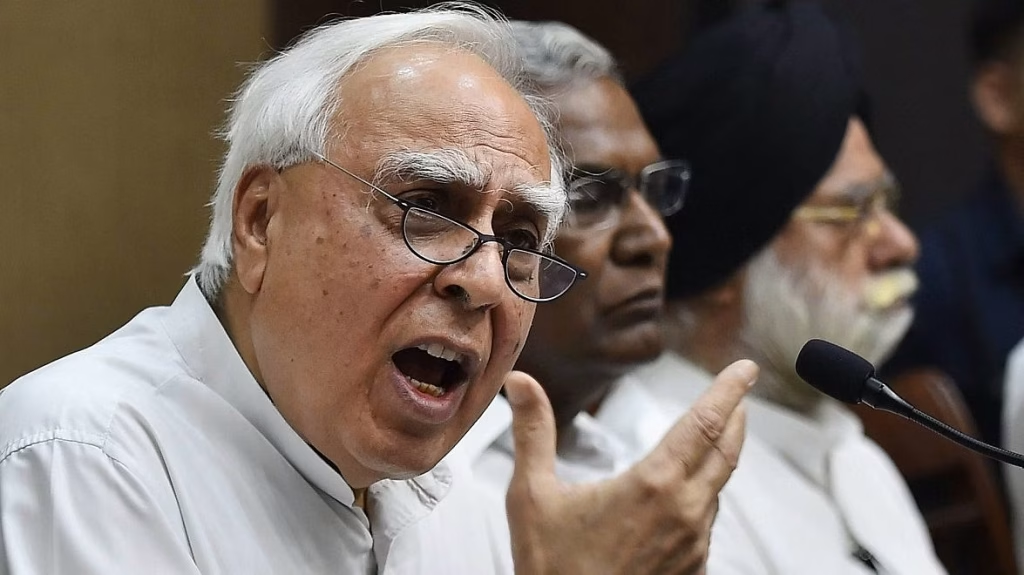
Sibal commented on the Supreme Court’s initiation of an inquiry following the discovery of cash at the residence of Delhi High Court judge Justice Yashwant Verma. He emphasized
“the importance of waiting for the inquiry’s conclusion before making any judgments“
Sibal stressed that
“premature conclusions could damage the credibility of the judiciary. He highlighted three key issues affecting the judicial system: financial corruption, alleged sexual misconduct, and ideological alignments”
According to him, the judiciary has not sufficiently addressed these issues, leading to questions about its institutional integrity.
Sibal expressed concern that
“if the judiciary does not address such issues transparently, it might lead to external interventions like the revival of the National Judicial Appointments Commission (NJAC)”
He stated that
“public debates on judicial failings should have occurred long before now”
Transparency, Sibal argued, must not be selective, referencing past instances like the Gogoi case and the Shekhar Yadav matter.
The Need for a Clear Mechanism in the Judiciary
Sibal proposed a more structured approach for the judiciary to handle allegations of corruption or misconduct. He suggested the establishment of a committee involving the Bar and other stakeholders to formulate clear responses to such allegations. The response to judicial misconduct, he argued,
“should not be the same as the response to ordinary acts of criminal misappropriation, given the far-reaching impact on public trust in the judiciary”
He further explained that
“judicial actions should be carefully considered to prevent reputational damage to the institution. Premature decisions, like assuming a judge’s guilt before a proper investigation, could undermine the integrity of the judiciary, irrespective of the final outcome“
The NJAC Debate and Government Influence

Addressing the government’s stance on the NJAC, Sibal noted that
“while the court had struck down the original form of NJAC, the government may attempt to bring it back in a modified version”
He raised concerns about the politicization of judicial appointments, pointing out that a significant percentage of high court judges are often government pleaders, leading to potential bias in the judicial system. According to Sibal, the source of recruitment for judges must be reformed to ensure a more impartial judiciary.
On Transparency and Accountability
Sibal also pointed to the lack of transparency in past cases involving judicial misconduct. He questioned why certain cases were not publicly disclosed and emphasized that transparency should not be selectively applied.
The need for a clear, consistent, and institutionalized approach to judicial accountability was central to his argument. He added that the
“judiciary should have its own internal investigative mechanisms to avoid external manipulation”
ALSO READ: Kapil Sibal Criticizes Election Commission, Calls It a “Sham” if System Continues
The Three-Language Formula and National Unity

Turning to the issue of language politics, Sibal expressed strong criticism of the three-language formula. He argued that the formula, promoted by certain political factions, was unrealistic and counterproductive. Sibal pointed out that
“the nation’s economic success is largely driven by the service sector, which relies heavily on English, making the push for Hindi as a national language problematic”
He also suggested that a blend of Hindi and Urdu (Hindustani) might serve as a better link language, given its widespread understanding across India. Sibal described the ongoing debate on the three-language policy as
“a diversion from more pressing national issues such as economic disparity, healthcare, and education”
Political Strategy for the INDIA Bloc
Sibal expressed concerns about the stagnation of the INDIA bloc, noting that the absence of a clear structure and communication among its members was hindering its effectiveness.
He advocated for the creation of a secretariat with a convener who could engage with various political parties and non-political stakeholders to foster cohesion within the bloc. Without this, he feared the government would continue its unchecked dominance.
Constitutional Issues and the Role of Media
Sibal concluded by touching upon broader constitutional issues, including the misuse of laws such as the Prevention of Money Laundering Act (PMLA). He criticized the way these laws were implemented and pointed out that the political use of state machinery to target opponents undermines public faith in the system. He also emphasized the media’s role in upholding the truth, especially when it comes to sensitive cases that involve reputations and privacy.
ALSO READ: Justice Hrishikesh Roy Shaped the Rule of Law with Clarity and Fairness: Kapil Sibal
Reflecting on His Political Journey
When asked about his departure from the Congress and his stance on internal reforms within the party, Sibal reiterated that
“he had no intention of criticizing the Congress”
While he had differences with the party, he expressed gratitude for the opportunities it provided him and affirmed his commitment to an inclusive India where identity is not defined by caste, creed, or language.
READ MORE REPORTS ON KAPIL SIBAL
FOR MORE LEGAL UPDATES FOLLOW US ON YOUTUBE
CREDITS: Kapil Sibal at Idea Exhange | ‘Corruption, misconduct, partisanship: Judiciary hasn’t responded to these issues institutionally… that’s disturbing’ – Apurva Vishwanath, National Legal Editor, The Indian Express