

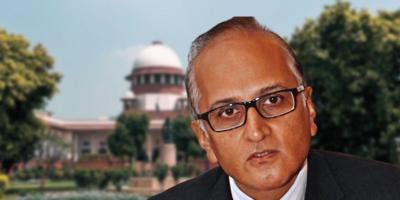
Retired Supreme Court Justice S. Ravindra Bhat remarked Today (March 30th) that the Supreme Court’s decision to uphold the abrogation of Article 370 of the Constitution failed to adequately tackle the central concern regarding federalism.
Thank you for reading this post, don't forget to subscribe!

Hyderabad: Retired Supreme Court Justice S. Ravindra Bhat highlighted a significant observation regarding the Supreme Court’s ruling on the abrogation of Article 370 of the Constitution, stating that it failed to adequately address the crucial issue of federalism.
Justice Bhat made this remark while reflecting on noteworthy judgments delivered by the apex court in recent times during the introductory session of the ‘Courts and the Constitution Conference’ organized by NALSAR University of Law in Hyderabad.
Discussing the implications of the Article 370 judgment, Justice Bhat noted,
“The other important judgment which has long-term implications is the Article 370 of the Constitution judgment. The Court spoke in unison through three judgments. It left unanswered an important issue on federalism.”
In December 2023, the Supreme Court upheld the Central government’s decision to abrogate Article 370, which had granted special status to Jammu and Kashmir. However, it refrained from ruling on the validity of a 2019 law that divided Jammu and Kashmir into two union territories (Jammu and Kashmir, and Ladakh).
Instead, the Court accepted the assurance from Solicitor General of India Tushar Mehta that Jammu and Kashmir’s status as a Union Territory was temporary and that statehood would soon be restored. Presently, review petitions challenging this judgment are pending before the Supreme Court.

Additionally, Justice Bhat touched upon other significant verdicts, including those in the demonetization case, electoral bonds case, and guidelines issued by the top court regarding the appointment of election commissioners. Reflecting on the trend of revisiting established norms, he remarked,
“This trend of examining and revisiting our norms, which were long held to be dearly held values, is not necessarily disheartening but is to be seen as the court probing and considering the changes which are necessary to be made, to make the Constitution responsive, efficient and relevant in the 21st century.”
Justice Bhat also noted similar instances in the courts of neighboring countries, where laws are scrutinized against constitutional norms to ensure their relevance in contemporary times. He briefly mentioned the case of Supriya Chakraborty and anr v. Union of India, where the Indian Supreme Court declined to recognize any rights for same-sex couples to marry. However, he refrained from commenting further on the verdict, stating,
“As a member of that bench, I would desist from commenting on it.”
Concluding his address, Justice Bhat urged society to contemplate the implications of generative Artificial Intelligence (AI) on norms and policies. He emphasized the need to adapt to technological advancements, stating,
“It is time that we all put on our thinking hats to collectively refashion norms to meet these challenges, which are profoundly dictating social change.”
Click Here to Read Previous Reports on Article 370
Click Here to Read Previous Reports on Justice Ravindra Bhat
FOLLOW US ON YOUTUBE FOR MORE LEGAL UPDATES