

The Lok Sabha debate on the Waqf Amendment Bill turned contentious as BJP leader Ravi Shankar Prasad accused Congress of vote bank politics and the cases of Shayara Bano and Shah Bano.
Thank you for reading this post, don't forget to subscribe!

NEW DELHI: The Lok Sabha debate on the Waqf Amendment Bill took a sharp political turn as BJP veteran Ravi Shankar Prasad launched a scathing attack on the Congress party, accusing it of vote bank politics in handling Muslim personal law issues. Citing the landmark legal battles of Shah Bano and Shayara Bano, Prasad criticized the Congress-led governments of the past for their inconsistent stance on women’s rights, particularly in the cases of maintenance for divorced Muslim women and the practice of triple talaq.
BJP’s Charge: Congress “Surrendered” to Hardliners

During his speech, Prasad slammed the Rajiv Gandhi government for bringing a law that effectively nullified the 1985 Supreme Court verdict in the Shah Bano case, which granted maintenance rights to Muslim women after divorce. He further accused the United Progressive Alliance (UPA) government of deliberately stalling legal proceedings in the triple talaq case, allegedly delaying justice for Muslim women until the Narendra Modi-led BJP government stepped in.
“The Congress has never recovered from the mistake it made in the Shah Bano case when it bowed to conservative forces. Since then, it has never won a majority on its own,” Prasad remarked, drawing a connection between the party’s electoral decline and its appeasement politics.
The Shah Bano Case (1985): A Turning Point in Muslim Women’s Rights


The debate brought renewed focus on the Shah Bano case, a watershed moment in India’s legal history concerning the rights of divorced Muslim women.
- The Case:
Shah Bano, an elderly woman from Indore, was divorced by her husband, Mohd Ahmad Khan, in 1978. Left without financial support, she moved court seeking maintenance under Section 125 of the Criminal Procedure Code (CrPC)—a provision that applies to all Indian citizens regardless of religion. - The Supreme Court’s Landmark Judgment:
In 1985, the Supreme Court ruled in her favor, declaring that Muslim women, like women of other religions, were entitled to claim maintenance under CrPC if they were unable to sustain themselves post-divorce. The judgment emphasized that there was no contradiction between Muslim personal law and CrPC’s provisions for maintenance. - Congress’s U-Turn and Backlash:
The verdict sparked outrage among conservative Muslim groups, who saw it as interference in Sharia law. To appease religious hardliners, the Rajiv Gandhi-led Congress government passed the Muslim Women (Protection of Rights on Divorce) Act, 1986, which overturned the Supreme Court judgment. This law restricted a husband’s financial obligation to the three-month iddat period post-divorce, shifting the burden of maintenance to the woman’s relatives or the Waqf Board. - BJP’s Criticism:
The BJP has consistently used this decision as an example of the Congress party sacrificing gender justice for political expediency. According to Prasad, “Had the Congress upheld the Supreme Court ruling, it would have sent a strong message in favor of women’s rights. Instead, they chose to reverse it, setting back reforms for decades.”
The Shayara Bano Case (2017): BJP’s Stand Against Triple Talaq
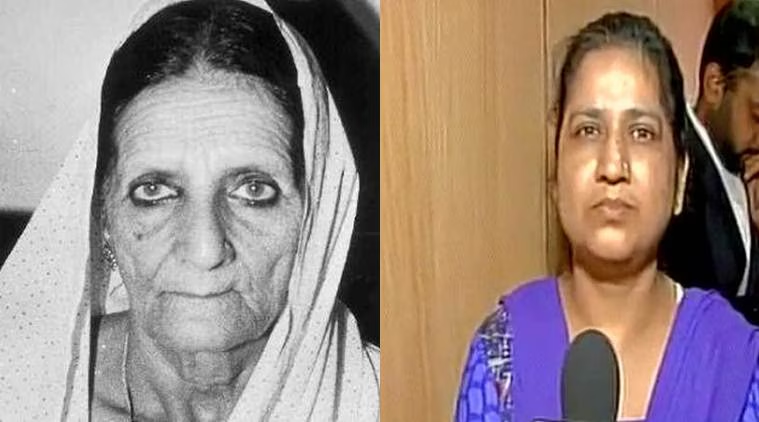
Drawing a parallel with the Shayara Bano case, Prasad accused the UPA government of deliberately delaying legal proceedings to avoid taking a clear stand on the issue of triple talaq.
- The Case:
Shayara Bano, a woman from Uttar Pradesh, was given instant triple talaq (talaq-e-bid’aat) by her husband Rizwan Ahmed in 2015. She moved the Supreme Court, arguing that the practice of a man unilaterally divorcing his wife by uttering “talaq” thrice in one sitting was arbitrary, unconstitutional, and violated women’s fundamental rights. - The Supreme Court’s Verdict:
In 2017, a five-judge constitutional bench ruled 3-2 in favor of banning triple talaq, holding that it was not an essential part of Islam and was manifestly arbitrary, violating Article 14 (Right to Equality). - Congress’s Alleged Delay vs BJP’s Action:
Prasad alleged that the UPA government (2004-2014) intentionally avoided taking a stand on the issue, keeping it in legal limbo. In contrast, the Modi-led BJP government took decisive action, with Prasad recalling:
“When our government came in 2014, Prime Minister Narendra Modi instructed me as Law Minister to clearly state in court that our government is against triple talaq.” - BJP’s Legislative Action:
Following the verdict, in 2019, the Modi government passed the Muslim Women (Protection of Rights on Marriage) Act, 2019, which criminalized the practice of instant triple talaq, ensuring stricter legal protection for Muslim women.
ALSO READ: LEGAL EXPLAINER| Waqf & The Waqf Amendment Bill 2024: Key Legal Changes & Impact
Congress Accused of Vote Bank Politics
Throughout his speech, Prasad repeatedly accused Congress of appeasement politics, questioning:
“How far will the country go for vote bank politics? Is the dignity of women negotiable?”
He asserted that Congress’s reluctance to uphold legal rights for Muslim women was a major reason for its electoral decline.
“Rajiv Gandhi won 400 seats in 1984. Since then, Congress has never won a majority on its own. Why? Because they sacrificed principles for political gain.”
The Waqf Bill Controversy: BJP vs Opposition


The debate on the Waqf Amendment Bill—which seeks to revise the governance of Waqf properties—became another battleground for BJP and Congress.
- BJP’s Justification for the Bill:
The government maintains that the amendments are necessary for improving transparency, regulation, and administration of Waqf properties. - Opposition’s Objections:
The Congress and other Opposition parties argue that the Bill was rushed through without adequate parliamentary scrutiny. They claim that the Joint Parliamentary Committee did not incorporate opposition MPs’ suggestions, alleging that the amendments aim to politically polarize the electorate by targeting minority communities. - BJP’s Counterattack:
BJP leaders, including Amit Shah and Ravi Shankar Prasad, have dismissed the Opposition’s concerns, accusing Congress of trying to maintain control over Waqf properties for political gains.
A Political and Legal Flashpoint
The debate surrounding Shah Bano, Shayara Bano, and the Waqf Bill highlights the deep political fault lines in India over Muslim personal laws, gender justice, and religious rights.
While BJP presents itself as a reformer, ensuring legal protections for Muslim women, the Congress faces accusations of failing to stand by landmark court judgments for fear of losing political support.
With upcoming elections on the horizon, this issue is likely to remain a key political weapon for both sides as they battle for public perception and electoral advantage.
FOR MORE LEGAL UPDATES FOLLOW US ON YOUTUBE
